05 January 2012

Notes

I was just researching works of art for the exercise that I did yesterday but wasn’t satisfied with and it is fun so far – I designed my own ground plan and it is much easier this way. I found this amazing sculpture artist – his name is Ron Mueck and his sculptures are over life size sculptures of heads, bodies in different situations –very inspiring!
Ron Mueck Seated Boy

04 January 2012

Project 1 Exercise: Exploring modern art

Project 1 Exercise: Exploring modern art

Surrealism:

-          Began in 1920s
-          Surprise and unexpected ways of presenting a subject
-          Developed form Dadaism
-          Wanted to free people from false rationality
-          Dream analysis was a bag part of the movement – believed that dream was a big part of art
Surrealism and politics and social change:
-          Artistic idea and political change is what they wanted
-          free revolution
-          anti-colonial revolution
-          Embraced anarchism?

The Golden Age of Surrealism:
-          Dali and Magritte were the most famous artists from the Golden Age
-          Recreating normal objects into an environment that isn’t usual for it and then moving it away from its original purpose and creating new meaning with it
-          Combination of depictive, psychological and as said above the estrangement of objects, abstract

Examples of Surrealistic Art:

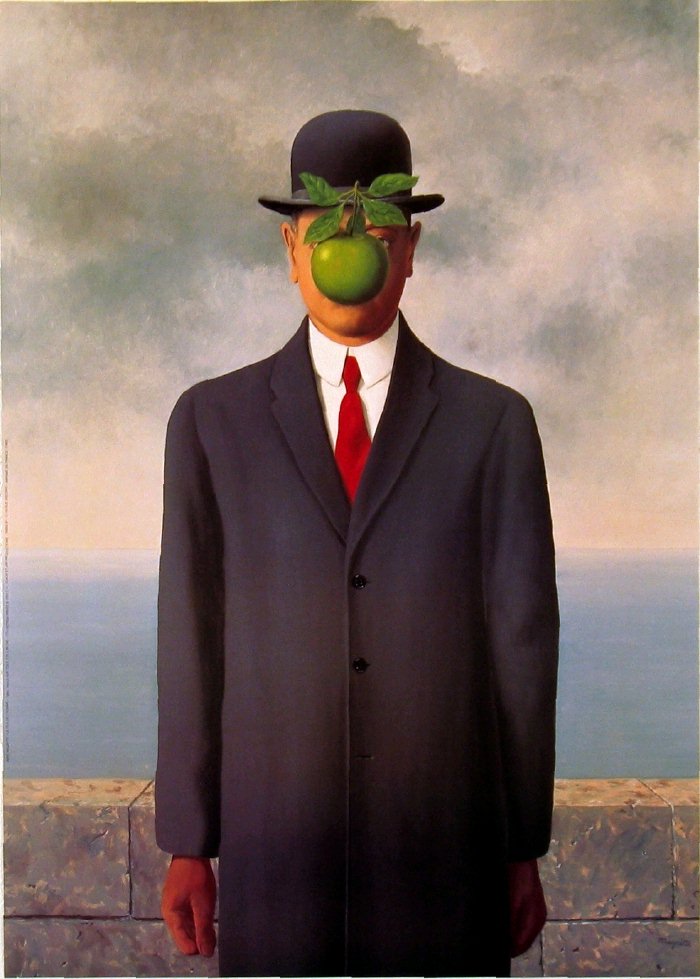
Rene Magritte (1964) The Son of Man (oil on canvas) Private Collection
Rene Magritte’s art has been used for book cover, CD covers, postcards; it has even been used in advertisements for brands like Huge Boss.  His art look familiar as almost everybody has already seen bits and pieces of his work – he is famous for using apples as a dominant feature in his paintings as well as not showing the face of the person he is drawing.

For example:

Rene Magritte (1928) The Lovers  (oil on canvas) New York: Museum of Modern Art
Creating some sense of intimacy but that being separated by the fabric covering up their heads – separation of intimacy – what did he want to say? Maybe they wanted to be lovers but weren’t allowed to be lovers? Maybe those two were a couple, maybe married but they kept things from each other that might be why there is no real intimacy. Hiding true feelings/ identities? Is there something that they are both not saying – or not allowed to say? Does is represent death?

After doing some research: Magritte’s mother drowned when he was still young and he watched her body being fished out of the river – a nightgown was covering her face. That might explain why in a lot of his paintings faces are covered up by some sort of object whether it be fabric, apples, flowers, et cetera. Magritte didn’t agree with the explanation of trying to cope with his mother’s death he only pointed out that his images were visual art of mystery/nothing/dream – Magritte wondered if people are reading too much into art – instead of just letting it be art they interpret images and sculptures.

References:

Web pages:
Bibliography:
Murray, P. And Murray, L. (1997) Dictionary of Art and Artists. Revised 7th ed. London: Penguin Group

The next exercise that I’ve been working on was the “Finding affinities” one and I have to say that it looked easy at first but when I started looking at ground plans I realised that it would be more than I thought it would be. I finally found a ground plan that satisfied me and because while reading in the big book about architecture and the International style I had laid an eye on the Villa Savoy and it was great that I found a ground plan to work with – I enjoyed looking at paintings, sculptures and furniture. This was actually the first time I actually looked into furniture a little more and I found it very interesting what I found – for example finding the Astor Hotel magazine rack was great I love the design and it fits perfectly in the living room of the Villa. What I also enjoyed was the difference between the art that was displayed in the public areas of the house e.g. foyer, living room, terrace and the difference to the paintings that were hanging in the mast bedroom and the dressing room where the paintings became more abstract and colourful. I enjoyed this exercise but I also found it quite hard as it was something where I wasn’t a 100% sure of what I was doing. But I feel like it would be great to actually see the art pieces that I chose hanging/standing in the Villa Savoy. I am actually not completely satisfied with my report about the house - that's why I am thinking about doing it again...

03 January 2012

Research point


Research point

Seurat’s painting technique: “pointillism”
-          Small distinct dots of “pure” colour (on palette, colours weren’t mixed but kept separate)
-          Blending of colour dots into various colours
-          Colours were used in system of colour wheel
-          Most paintings with pointillism technique are done with oil paint (reasons for using oil paint: thickness and because it doesn’t run down the canvas)
-          Short even brush strokes, every stroke separate from another one
 Seurat was more working-class than other Impressionist artists and although his political stance isn’t certain some speculates if he was involved with the ideas of Diversionists as this could explain why he “developed” a new painting technique that is called Divisionism/pointillism.

References:

Web pages:

I am now going to annotate a Post-Impressionist painting and I was looking forward to this annotation and I am very excited now to choose a painting. I chose Van Gogh’s “The Starry Night” and I found it very interesting to do some research on the background and look at things that Van Gogh wrote to his brother it is very fascinating to see what was going on in the mind of such a great artist. I am also still very fascinated by the fact that Van Gogh made about 800 paintings in his life time and 70 paintings within the 70 before he committed suicide.

I decided to do my virtual town house visit to Haworth Parsonage as I admire all the books that the Bronte sister wrote and I am very excited that the house where they lived can be actually visited I didn’t know that that was possible. As I am a lover of those classical novels I can’t wait to dive in to their home and see where they came up with their amazing stories on longer winter evenings. 

02 January 2012

Project 4 Exercise: Depicting everyday life

Poppy Field in Argenteuil, 1873, Claude Monet, Musée d’Orsay (oil on canvas)


Luncheon of the Boating Party, 1881, Renoir, The Phillips Collection Washington (oil on canvas)


They are very attractive images to the viewer as for the choice of colour, scenery, subject. It shows the cheerful life without any worries, just a pleasant time with friends in a beautiful setting. Everybody looks happy and it is still the idealised version of a life even today. The first image by Monet doesn’t tell the viewer anything about city life but it shows a harmonic scene, a woman and a child, probably mother and daughter walking through a field of poppies.  A house in the background and blue skies underlining the light-hearted atmosphere. The painting from Renoir tells the viewer more about city life although it isn’t set in a public place e.g. restaurant etc. But it shows the general idea of how communication and getting together in the 19th century looked like. Men and women both dressed in formal clothes except for the boats men. Enjoyment of food and wine, laughing and drinking. I am wondering what the woman on the right who is covering her ears means to this painting – if it is an indicator of something deeper in meaning that the image shows when you first look at it. 

Notes

I just finished annotating a realist image and analysing a painting of a historical event and I have to say that annotating became more fun with every image I annotated so far as I start knowing more about the background of things and for me art becomes more interesting when it transfers from Romanticism to Realism and I am about to start reading about Impressionism which is one of my favourite art periods and it is very interesting to not only get a glimpse of things and bits and pieces of art history but to actually understand the context and how one art period transferred to another one and how it was influenced by different things and how every art period also wants to express something else. It is a lot of fun doing this! I still have a hard time with reading about architecture and photography as I don’t know much about it and I mostly went to museum to see actual paintings from different art periods rather than looking at architecture and photography from back then.