Showing posts with label Visits. Show all posts

19 December 2011

Visit an art gallery

Yesterday I visited an art gallery and it was really interesting to see how much I already learned during this short period of time. I mean I could identify some of the paintings and what century they might be from and what art style they were. I also saw another painting of a Saint painting Viring with child as in the image that I annotate from Jan van Eyck and I got really excited that I knew some things to say about to my father who accompanied me. I also saw this one really amazing painting and I stood in front of it for probably 20 minutes because I was so fascinated by what it meant in a deeper sense. It was a painting from Franz Radziwill (1895 – 1983) and it was called “The Strike” (1931)


and although the LWL – Landesmuseum für Kunst und Kulturgeschichte is quite a small museum and gallery compared to for example the National Gallery in London or Galleries in Australia, they had many amazing paintings and I got a lot from visiting an art gallery and writing about how the building and everything fit together with the art that was shown. I researched something about this painting after I got back and it was very interesting to read about it what it meant and of course about the artist himself as this often gives some kind of hint about what the painting could mean. Franz Radziwill orientated himself at other expressionist paintings but within his career his style changed to a more subtle style and his paintings were the new version of German romanticism. This painting shows an empty city, it shows a coffin, empty railtrails, airplanes, empty streets, etc. Franz Radziwill wasn’t a big fan of realism he maybe wanted people to pay more attention to the things behind reality, to the things behind the business of the world and to get the viewer to increase his/her awareness of the things that aren’t obvious or that one doesn’t see in everyday life. What is also interesting is that some of the details that can be seen on this painting were added later after finishing the painting in 1931. I think that this painting is amazing as I could find a lot of different ways to interpret all the small details that are shown in this painting.
References:
Web pages:
I also got a few postcards of different works of art in the museum shop and I am very happy that I found a place where I can buy postcards that show paintings different art periods as I found it hard to find any shops that sell those close to where I live. I am still very excited that I was allowed to touch (!) a Henry Moore sculpture yesterday; it was really fantastic and it felt great touching the cold bronze surface and feel the shape of the sculpture flowing underneath my hands. I was also able to spin the sculpture as it was only a small one on a disc and it was great to see the sculpture from all different sides and angles. I am eager to write a report about my museum visit now and order all the information that I stored in my head and took notes about.
What I want to take a look at also today is Chapter Eleven about the 16th century in Europe. I have been looking forward to the second part of the course as I feel like my interest is more in the art from 14th century onward. I am also thinking about watching the episode about Northern Renaissance from the “Art of the Western World” series.
Watching the video made me remember all the details about what I learned during the last project of part 1 and I am eager to read about the 16th century now. I finished reading about the High Renaissance in Europe and I just find it very interesting and I can’t wait to research some things and learn more about the stories behind the painting as in the research point about researching the mythology behind three paintings – I am looking forward to that, that is going to be interesting!

13 December 2011

Visit a Gothic church

Today I visited Cologne Cathedral and I took some pictures and made sketches. Unfortunately my camera broke and all the pictures turned out to be blurry, I am a little upset about that but I guess I am just going to use images from the internet. It was fun to visit again and although I’ve been there 3 times now I still feel small when I enter the cathedral and its majestic architecture and height is phenomenal. I am going to write a report about it now. I think it’s a great method to visit different places to see the things for yourself and I feel like I pay so much more detail now already to everything that I see because I’ve learned quite a bit about architecture and its meanings et cetera.

è Visit a Gothic church
  Image from http://www.essen-und-trinken.de/food/images/topthemen/feste/weihnachten/weihnachtsmarkt/koeln.jpg (Accessed 12 Dec 2011)

The Cologne Cathedral was started being built in 1248, it took until 1530 to finish the Gothic choir and because of money issues the building was not completed until 1880 when the two towers in the West were finished that made Cologne Cathedral one of the tallest churches in the world. It is also known for its length which is approximately 145 m and the height of the two towers is around 158 m.
During World War II it was hit by quite a few bombs but it survived and in 1998 the reconstruction and restoring of the Cathedral began. Even today there are still although only a few constructions on the Cathedral. 
The Cathedral is also known for its excavations, tomb monuments of important archbishops et cetera. One can find the excavations underneath the Cathedral, one would find parts  of the old cathedral, old stone columns to help them stabilise the building while working on its construction around 1500, the old fundament of the Cathedral before improving it with new architectural design and knowledge of how to built things in a more effective way, one would also find parts of the old floor from Medieval times, a part of a „street“ from the Roman Cologne, tomb monuments and sarcophagi, a well shaft from around 1400 and very interesting Roman construction from 2nd/3rd century that was meant to be some sort of heating system for the Roman house that had been there before they had started building any cathedral there. Other excavations are tombs of bishops, princes, princesses or other important historical figures (see Fig 4.1 for an example).
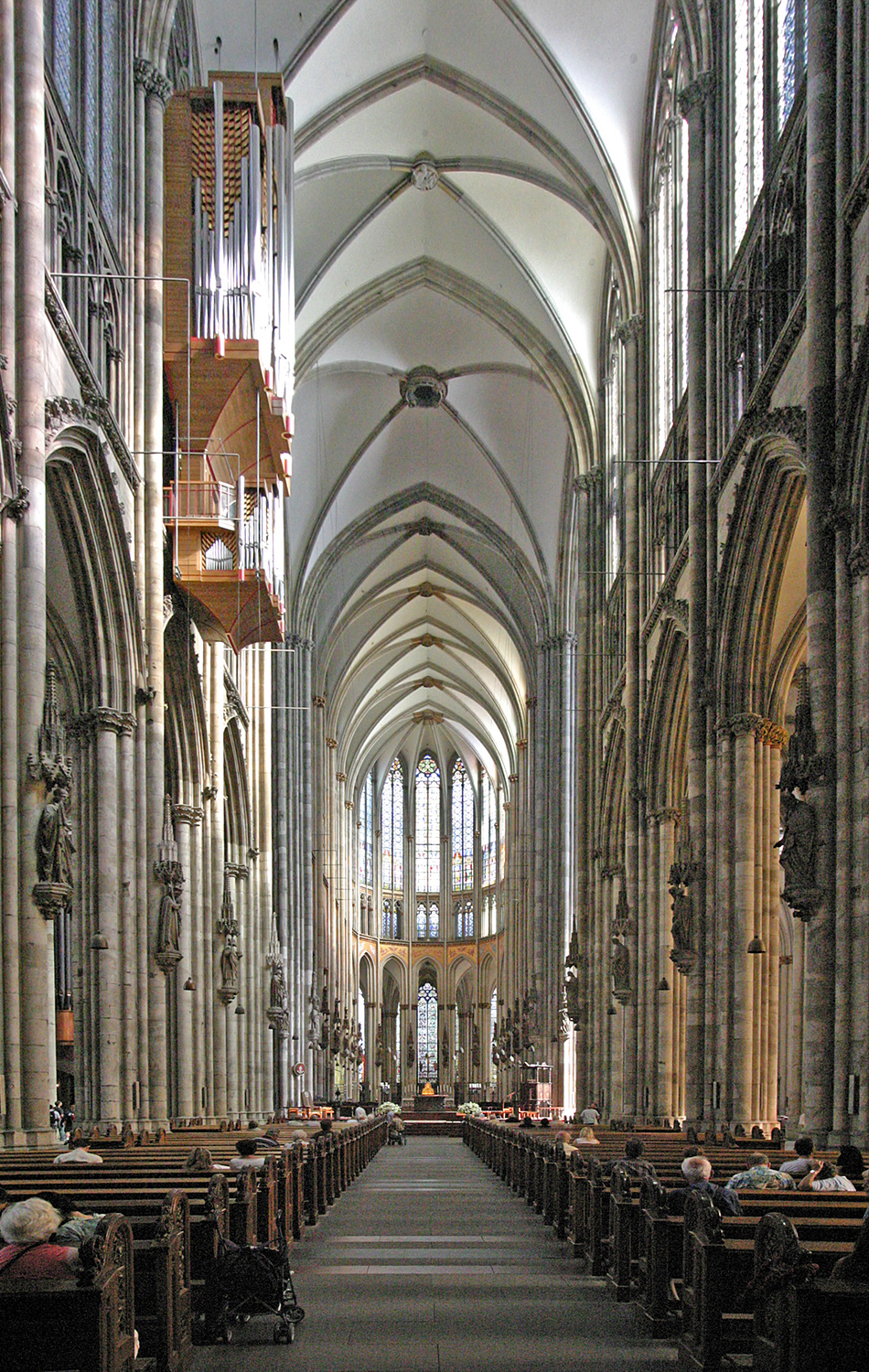
The moment one would step inside one would feel small walking down the majestic nave, with its detailed arches on each side, the sculptures of saints, apostels and angels built into the columns between the arches and the light that falls into the Cathedral and underlines the form and structure of the Cathedral’s architecture.

Image from http://upload.wikimedia.org/wikipedia/commons/7/71/Koelner_Dom_Innenraum.jpg                                      (Accessed 12 Dec 2011)
Cologne Cathedral is able to fit 4000 people, it has 1200 seats and 2800 people can stand. The great acoustic in the Cathedral can be attributed to the stone vaulting architecture that allows the music to be echoed across the room, which makes the music sound „so joyfully that their song, delightful by its consonance and unified harmony, was deemed a symphony angelic rather than human“ (Abbot Suger on the Abbey Church of St-Denis and its Art Treasures, ed., tr. and annotated by E. Panofsky, Princeton 1979 – from  Honour&Fleming, A World History of Art, Laurence King Publishing, London, 2009).

                                                                                                    Image from                                                                                                                 http://en.wikipedia.org/wiki/File:K%C3%B6lner_Dom_-_Blick_vom_s%C3%BCdlichen_Obergaden_in_den_Obergaden_des_n%C3%B6rdlichen_Chorraumes.jpg                                       (Accessed 13 Dec 2011)
                                                                                                        
 The arcades are known for their detail. The columns are decorated with saints and musical angels (see Fig 3), on the spandrels painted angels overlook the cathedral and the detail of the tracery is extraordinary. The upper arcades show the magnificence of glass work. The arches are always crowned with a three-leaved flower and they always follow the same rhythm of architectural structure. There is always one big arch, four small arches inside which one can find 8 more and on top of they are crowned with the flower, on top of that are the stained glasses that tell a biblical story (see either above or Fig 5).
What one would also find inside is a various number of sculptures – of saints, apostles or Virgin Mary and Saint Peter (see Fig 3.1). Cologne Cathedral is also known for its Shrine of the Magi (1164) and it is placed in the East corner and on one end of the long nave (see Fig 2 for ground plan).
                                                                                                                
 Image from http://www.koelner-dom.de/16797.html?&L=1 (Accessed 13 Dec 2011)
It shows images of the Last Judgement and can be found behind the high altar of Cologne Cathedral.
The surface of windows in the cathedral is approximately about 10.000 qm and the stained glass in the different windows tell different stories, e.g. Adoration of the Margi or the Coronation of the Virgin from 1330 (for an example of a window design see Fig 4.2).

  Image from http://en.wikipedia.org/wiki/File:Cathedral_2_by_andy205.jpg (Accessed 13 Dec 2011)
This image shows another example of a window design and it also shows the richness in detail of each character shown in the story that the window is supposed to tell. The window in the middle shows the Lamentation over the dead Christ and the Last supper on the top.

 Image from http://en.wikipedia.org/wiki/File:Cologne_Cathedral_Maurice_van_Bruggen.jpg                                      (Accessed 13 Dec 2011)
This photo shows the West facade of Cologne Cathedral, it is perhaps the most famous side of the Cathedral because of its two towers. There are 3 portals (entrances) on the West, East and South facade of the building. Each side has a main portal and two outer portals which always display a saint. The West portal’s main entrance is the Virgin Mary portal and the one on the left is the Magi and the one on the right is the Saint Peter portal (see Fig 1 and Fig 1.1 for more detail). The main portal shows Mary with child surrounded by Cathedral’s most important saints showing the age before redemption. There is lots of detail to see in the door and doorknobs (see Fig 1.2).
If one would walk around the Cathedral one would find flying buttresses on each side of the building, stabilising the fundament and adding another piece of great architecture to the Cathedral.

 Image from                                                                                                    http://en.wikipedia.org/wiki/File:K%C3%B6lner_Dom_-_S%C3%BCdportal_gesamt_-_Domwallfahrt.jpg              (Accessed 13 Dec 2011)
When one would get to the South facade of the Cathedral one could see the difference between the West facade and the South facade’s design in architecture. It isn’t as high or majestic but it gives a great view on the flying buttresses on the side. Unfortunately no original plans from medieval times survived which meant that the architect had to make new plans orientating him on the plans of the West facade. The South facade was finished around 1855 but it took several years to decorate it with sculptures.
Lots of detail can be found on the outside of Cologne Cathedral. The ornamental design is very detailed and majestic. Looking up from the ground not a lot of detail can be seen, but looking at pictures that show close-ups from the upper part of the building one would find lots of detail and meaning in every detail (see Fig 2.1 and 2.2).
Cologne Cathedral is visited by 10 000 people each day and Cologne was the place for the “Kirchentag” in 2007 which is a big festival for church and religion, belief and celebrating one’s religion. It also is place for ceremonies e.g. mass, weddings, christenings and more. It is one of the most popular places where pilgrims go. After the definition of Abbot Suger’s Abbey of St Denis that set the standards for Gothic architecture as “architecturally majestic and rich in glass and carved decorations – new Jerusalem” (p. 378-9, Honour&Fleming, A World History of Art, Laurence King Publishing, London, 2009) Cologne Cathedral would be called “new Jerusalem” as it is rich in glass and carved decoration and the feeling of majestic architecture is obvious as for height and length of the Cathedral.

References:
Web pages:

Bibliography:
Honour&Fleming, A World History of Art, Laurence King Publishing, London, 2009
Werner Schäfke, Schnellkurs Gotik, DuMont Literatur und Kunst Verlag, Köln, 2007

Remark: Unfortunately my camera broke and all pictures turned out blurry that’s why I have been using images from the internet. 


my sketches

04 December 2011

Visit a classical building

Today I went to visit the classical building I had chosen and I had a fantastic time. It was cold and I couldn’t feel my fingers after some time sketching outside – but it was worth it – and I could even go inside and warm up afterwards. Loved the building and its architecture! Plus it was raining all week and it was supposed to rain today too, but it didn’t and the pictures turned out quiet good – all in all a successful day so far! Although I was a little disappointed that there weren’t  more information about the architect or the building itself.

è Visit a classical building


Image from http://static2.akpool.de/images/cards/25/256617.jpg (Accessed 4 Dec 2011)

The neo-classical “Wandelhalle” is located in the 30 hectare park of the town Bad Oeynhausen, which is in the West of Germany. In 1847 the Prussian Director of Gardening, Lenné, made his first draft of the park that was going to be a retreat for all the people living in the city and a place for extravagant buildings, later in 1903 another architect remodelled parts of the park and in 1925/26 the architect “Regierungsbaumeister Müller” built the “Wandelhalle” and located it in the upper part of the park.


It was built to replace the old pump room. The front of the building shows the classical form of the temple architecture and in order to frame the front and make it an eye-catcher  the architect used Ionic order with its ornaments at the top. Two arched side wings were both built with columns in the Doric order; on top of each side wing there is a sculpture by Prof. Julius Hoffmann that symbolise water and health. In the 1960’s the building was remodelled and in 2002/2003 the “Wandelhalle” was again remodelled and restored. Today it is used mostly for concerts and private use (e.g. weddings). The side wings are now little shops for antiques, clothes, art and even a hairdresser is located in the right wing.

Looking at the floor plan below one can see that the side wings are mirrored and have the exact shape, the same number of Doric order columns (9 columns) and that at the front and the back of the building 6 Ionic order columns frame the main hall. Plus there are 4 block columns at each corner that maintain the feeling of a clean-cut building.


Sketches of columns (block “columns” corner, Doric column, Ionic column)


The whole building fits perfectly in the grounds. Other historical buildings are also located in the park and the “Wanderhalle” especially fits great into the landscape design. There is a small fountain in the middle of the park pointing towards the front of the “Wanderhalle” (see below) and underlines the square, clean-cut feeling of the building.


One should have another look at the sculptures on each side of the building as they point out for what purpose this house was used as they are named “health” and “water”.

The sculpture on the left side wing could almost be called a classic male nude, except for the shell that is covering the sculptures sex. The detailed muscles could be an indicator for an artist who orientated himself at Greek sculptures or Italian sculptures, but the profile of the sculptures head doesn’t show the classic fine Greek profile and the face structure more resembles the features of Northern European people.

“water”

                 On the other side wing one would find this statue:

“health”

A woman taking care of two children, the bare chest maybe indicating the nurturing care of a mother.  The composition of size/theme of the two sculptures is a perfect way to resemble the history of the building although not  many people might pay attention to them as they walk by the impressive front and columns of the “Wandelhalle” and don’t look up.

If one would take a look inside one would find a bright room with two arched windows on each side of the hall that give you a nice view over the park. 2 double wing doors where you can enter and leave the building, 2 fake doors for more light coming in to the building and 4 internal doors are the main doors on the ground floor. On the first floor open balcony one can find 2 other internal doors. The main hall has a square shape and there are 4 chandeliers hanging from the ceiling that has been divided into 121 small squares underlining the hall’s symmetrical appearance. Two basin like sinks can be found next to one of the two arched windows on each side.


The inside is very clean-cute but if one would look up to the ceiling one could see that there is also lots of detail in the little things. In every small square at the ceiling there is a bronze plate decorating it (as you can see below in the sketch), and all 4 chandeliers have 16 lamps and 32 small bronze sticks that hold everything together. On each side on the first floor balcony are 10 small lamps on each column. The walls are also very detailed with the exact same space between all columns and the small frieze on the first floor balcony. There is a very good acoustic in the main hall and concerts are held 2 to 3 times a day.


These two brochures are full of information about what kind of concerts take place in the “Wandelhalle” and what other activities one could go to in the spa park Bad Oeynhausen.