Projekt 4 Exercise: Humanism
1) Did an interst in humanism mean a movement away from Christianity?
2) How was an interest in the classical world reflected in Renaissance art?
3) Was it possibly successfully to combine Christian and classical elements in painting, sculpture and
architecture?
architecture?
During Medieval times paintings, sculptures and reliefs that showed humans and saints in one setting the thing that was most conspicuous was that saints were always shown taller than humans, more colourful than humans, what is also very is that the background of paintings, reliefs that showed saints most of the time had a golden background. It all changed with the influence of humanism. Humans and saints matched in their height and the background changed from gold to a much simpler background. Artists wanted to tell stories in front of a landscape in the background as to make it look more realistic more naturalistic. The gap between otherworldy and reality was closed. What also was an important factor to think about was that in early Renaissance fresco became more and more important and they were painted on church walls. There are several reason why churches became wall paintings. First reason was that the persons who were unable to read would be able to understand the stories that were in the bible, secondly it was important for the church to transport the emotions of the story to other people and they thought that it was easier to do through the power of paintings and thirdly people would remember paintings better than stories they would hear.
Humanists recreated the values from ancient Greek and medieval Europe; they turned the medieval ideals of chivalry and nobility or the rang given by birth into individual prowess and individual abilities that each and everyone had to offer. The wanted to establish the importance of civic virtue and self-reliance.
In the early Renaissance Brunelleschi discovered linear perspective which made every painting and relief look more real, more natural.
1) People interested in humanism weren’t anti-Christian but rather than giving thought about the hereafter they concentrated on the present. Of course some of the humanist’s ideals didn’t match with the Chrisitan ideals of obidient Christians, worshippers and church people and the expressing of individual perception, individual opinions about things that were going on in the world wouldn’t have been a supporting act for the church. Humanism can be understood as a movement away from Christianity but it doesn’t necessary have to be a movement away from it; it was rather a movement of self consciousness and awareness of the own person and being connecting to the outer world.
2) In ancient Rome the movement of naturalism and realism started and it was to be carried on during the Renaissance throughout new techniques of showing persepective and using different colours. What was still carried on from ancient Greek and Roman times was the idealisation of the body, still shown nude very often and the use of ancient architectural motives in the background. The believe of the classical world that miracles could happen also carried through Renaissance and humanism and it was still often portrayed in painting, sculpture and architectural decorations as ornaments and sculptures.
3) It was possible for example in the case of St. Sebastian – a painting that shows the condemned to be shot to death with arrows Saint, strapped to a classical column, showing gods and Greek letters carved into the stone of the column. In architecture columns and arches only developed further from ancient times, they turned churches into majestic buildings full of frescos telling stories from the bible, sculptures of Saints (still with idealised body and face) and use of reliefs over the entrance.
3) It was possible for example in the case of St. Sebastian – a painting that shows the condemned to be shot to death with arrows Saint, strapped to a classical column, showing gods and Greek letters carved into the stone of the column. In architecture columns and arches only developed further from ancient times, they turned churches into majestic buildings full of frescos telling stories from the bible, sculptures of Saints (still with idealised body and face) and use of reliefs over the entrance.
References:
Web pages:
Bibliography:
Honour&Fleming, A World History of Art, Lauren King Publishing, London, 2009
__________________________________________________________________________________
Giotto di Bondone:
I also got very interested in learning more about the artist Giotto when I found a book about him in my local library. He was one of the first to draw figures as they were individuals with imperfections; he separated himself from the ideal of a perfect human body and face and tried to stay true to reality when he painted. He was one of the first to make huge wall paintings in great churches, telling the stories from the bible, working with the newest material called tempera (it would dry very quick so there was a lot of work to be done before they could actually start painting, drawings and sketching on walls show that he put a lot of work in the art of fresco.
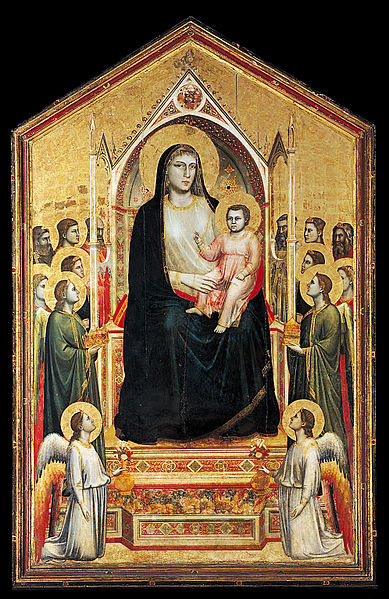 |
| Image from http://upload.wikimedia.org/wikipedia/commons/thumb/c/ca/Giotto_Ognissanti_Madonna.jpg/389px-Giotto_Ognissanti_Madonna.jpg (Accessed 14 Dec 2011) |
I was very fortunate and have been able to visit the Galleria degli Uffizi twice and I’ve seen this image in its original form and I remember being very fascinated with the details of the throne, all the faces and how the seemingly so similar looking angels and saints surrounding Mary and child don’t look that similar when you take a closer look. He developed paintings that were more emotional and naturalistic more accessible to everybody that’s why he painted the stories of the bible in churches.
References:
Web pages:
Bibliography:
Anne Mueller von der Hagen, Meister der Italienischen Kunst –Giotto, Könemann Verlagsgesellschaft mbH, Köln, 1998


